Showing posts with label 2012. Show all posts

Saturday, January 19, 2013

The Colosseum

On our last full day in Rome, we decided to hit the popular touristy spots.  First up, the Colosseum.  I don't know if this needs any introduction, but if so, here's the wiki.

The view from our front door.  Seriously.

Approaching from the street.


From underneath the outer walls, waiting in line.


From one of the lower decks, looking up at the nosebleeds. 

Translation: Hot Dogs: 30 gold pieces, Beer: 70 gold pieces ...

Middle decks looking down.  Note that the original "floor" was made of wood and has been destroyed over time.  Those are the chambers under the floor, and those folks are standing at would be ground level.


This is seriously the sign to the men's room.  Even the Italian bathroom signs have well dressed people.

Inside looking out to Palatine Hill (I think).

More looking out from the upper floors.
At this point, we left the Colosseum and passed under an arch on the way to Palatine Hill.


Arch detail.  Not bad, eh?

One final view from the hill.

Saturday, January 12, 2013

Walk to the Spanish Steps

After leaving the greater Pantheon area, we decided to head to the Spanish Steps (the long way).  Here's what we saw along the way.

Loneliest. Parishioner. Ever.
The Tiber River
Fontana del Nettuno (or Fountain of Neptune) at the North end of Piazza Navona.
Fountain of the Four Rivers, also in Piazzo Navona.
Detail from the Fountain of Four Rivers. 
Obelisk above fountain.
Why yes, I will live here.


We eventually found are way to the Spanish Steps, and apparently we weren't alone.  Keep in mind this is the "off" season.


The top!

View from the top.

Thursday, January 10, 2013

Santa Maria sopra Minerva

Literally around the corner from the Pantheon is one of the major Dominican churches in all of Rome; Santa Maria sopra Minerva.  The church is named such because it was built on top of a  building dedicated to the Egyptian god Isis, but incorrectly attributed to Minerva.  I guess Isis messes up the "a" at the end of each word anyway.

This was taken from the front of the church.  That's the Pantheon in center.

Despite the rich history of the church, and the fact that there's a Michelangelo statue inside, and the Pantheon literally across the street, there were very few tourists in the building or on the grounds.

The structure seen today was built in 1288, but the grounds themselves contained Roman artifacts dating back to B.C. times.  Apparently, some can still be found in the church's Crypt.

One of the most interesting details of this site is the obelisk out front being supported by an elephant.  I'm having a hard time simplifying the history, so here's what the Wikipedia page says:


In front of the church there is one of the most curious monuments of Rome, the so-called Pulcino della Minerva. It is a statue designed by the Baroque era sculptor Gian Lorenzo Bernini (and carried out by his pupil Ercole Ferrata in 1667) of an elephant as the supporting base for the Egyptian obelisk found in the Dominicans' garden. It is the shortest of the eleven Egyptian obelisks in Rome and is said to have been one of two obelisks moved from Sais, where they were built during the 589 BC-570 BC reign of the pharaoh Apries, from the Twenty-sixth dynasty of Egypt. The two obelisks were brought to Rome by Diocletian, during his reign as emperor from 284 to 305, for placement at the Temple of Isis which stood nearby. 
The Latin inscription on the base, chosen by the pope who commissioned the sculpture to support the obelisk found on the site, Alexander VII, is said to represent that "...a strong mind is needed to support a solid knowledge".
The inspiration for the unusual composition came from Hypnerotomachia Poliphili ("Poliphilo's Dream of the Strife of Love"), an unusual 15th century novel probably by Francesco Colonna. The novel's main character meets an elephant made of stone carrying an obelisk, and the accompanying woodcut illustration in the book is quite similar to Bernini's design for the base for the obelisk. The curious placement of the obelisk through the body of the elephant is identical.

Close up, showing obvious age difference between obelisk and base.


Stepping into the church is like stepping into some kind of mostly tourist-free museum.

Lookin from the entrance doors directly on to the main chapel.

From the right side of the chapel back toward the front doors.

The church is laid out similarly to those in Florence with the "main" chapel in the middle and several mini-chapels decorated and kept-up by wealthy families of the times located on each side of the building.

From the oldest mini-chapel.  I think this gentleman passed away in the 1400s iirc.
Most visitors, however, entered for the statue of Christ the Redeemer by Michaelangelo (although it has many other names).  See this page for more information.

Christ the Redeemer, on our left.
Finally, upon exiting the building, I noticed that markers had been placed where the Tiber had flooded over the years.  It often flooded where I grew up, but all we ever did was paint markers on retaining walls.


Upon leaving, the light was beautiful on a building across the street.  Here's my final photo for this post.


Wednesday, January 9, 2013

The Pantheon

The Pantheon, built in 126 AD, was originally a temple dedicated to "all gods" ("Pan" is Greek for "All" and "Theon" is roughly Greek for "Gods"), and has been in continuous use ever since.  The Roman Catholic church has been using it since about the 7th Century, AD.

One of the first things that I noticed about the Pantheon was the age / weathering of the exterior structure itself.  Rome is full of history dating back thousands of years, but the Pantheon "looks" ancient.  The material used is much different in color and texture from surrounding structures, and the architectural style stands in stark contrast to almost anything we saw in Rome (with the exception of the Forum).

Another first impression is the sheer size of the building.  Here's the approach to the front doors:


Another obvious feature of the building is the Oculus (aka: Big hole in the roof).  Because of the way the building was designed, the Oculos points a beam of light around the interior.


Another interesting feature of the Pantheon is that Raphael is buried there.  See:


Finally, I figured out that our camera has a movie feature.  Here's a quick video from inside the Pantheon looking from eye level and then into the oculus.


Sunday, January 6, 2013

St Peter's Basilica (Basilica Papale di San Pietro in Vaticano)


After spending most of the day in the Vatican Museums, we said to ourselves, "Hey, let's go stand in another ridiculously long line!"  Luckily this one was for St. Peter's Basilica which happens to be (a) free, and (b) unbelievably beautiful.

I can't even begin to explain (or understand) much of the history of the building and the contents therein, so check out the Wikipedia page here.


The line moves relatively quickly, and we made our way to the main entrance relatively quickly.
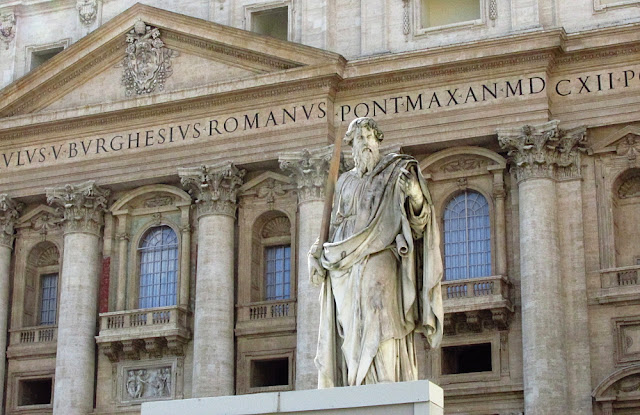
Statue of St. Paul

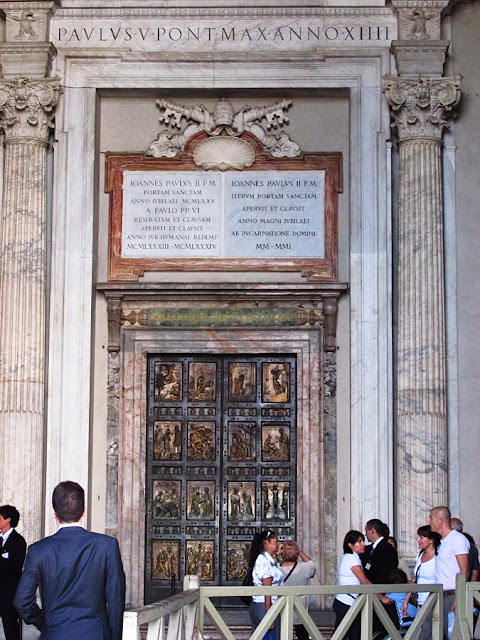
The Holy Doors at the main entrance.  Any Latin majors want to help me with the translation?  The body of John Paul II isn't far from here, so I'm assuming it has something to do with that.
St. Peter's is, hands down, one of the most spectacular museums / historical sites that I've ever seen.  Honestly, I think even the most devout atheist would agree.
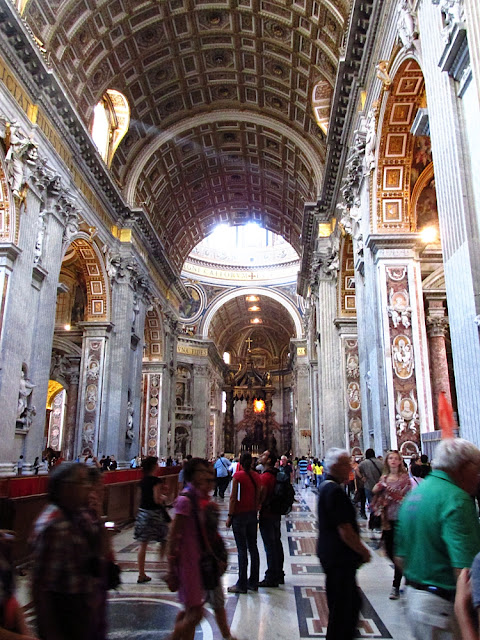
After walking in the front doors.

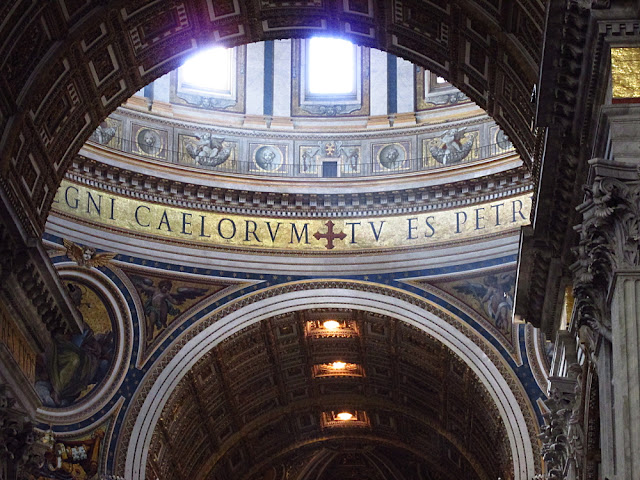
Impressive, no?  More Latin.

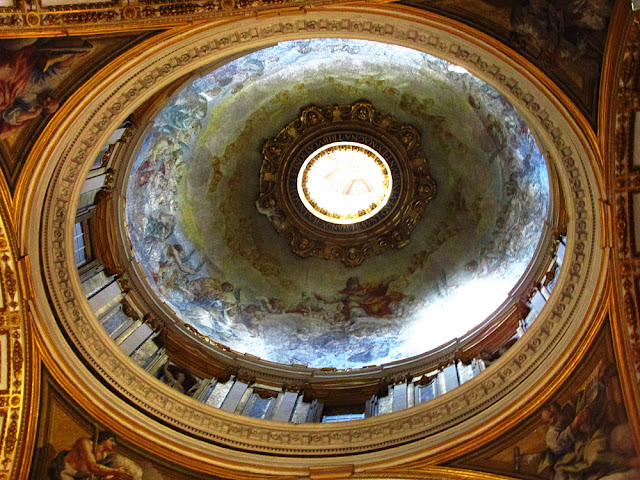
Just ONE of the domes (not the big one).


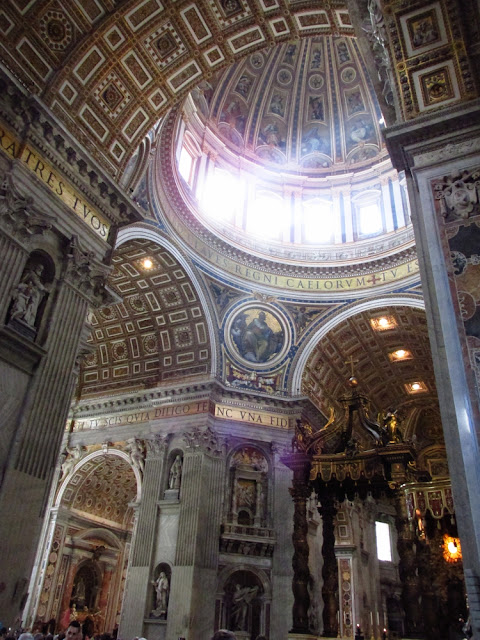
That's the "main" dome above with the alter (Baldacchino) on the lower right.
I took this just to get a sense of scale.  See also: this painting from 1731.
View above the alter/Baldacchino into the main dome.

More Baldacchino with the Cathedra Petri (or "Chair of St. Peter) in the background.
The sunbeams (Crepuscular Rays for you science folk), really add to the beauty of the building and art therein.  These photos really don't do it justice.


There are two "sites" within St. Peter's that are very popular with tourists, the Pietà and the Tomb of John Paul II.

The Pietà is a masterpiece work by Michelangelo, and the only work he ever signed (something he soon regretted and vowed to never do again).  Much more information, including some interesting interpretations of why Mary looks so young can be found at the Wiki page.


Finally, I wanted to see the tomb of John Paul II, arguably the most popular Pope in memory (if not "ever").  I highly respected the man and most of his teachings during his lifetime.


What I didn't take photos of was the awesome Vatican Grottos and Necropolis beneath the main alter.  We were able to see the upper level of the Grotto, but there's apparently a level below that, and another area with deeper / more hidden tombs.  The Necropolis is a much larger subterranean system that contains pagan gravesites as well as VERY early Christian tombs, including what is more than likely the remains of St. Peter himself.

If you'd like to find out more, this is the best link I could find, although the wiki page is also helpful.

- B